Building Six M2 Machine Guns for a World War II P-40 Warhawk
When the team at Soaring by the Sea approached us about building six aircraft-mounted .50 caliber machine guns for their World War II P-40 Warhawk, we knew this project would be unlike anything we had tackled before.
Over the years, we have worked on a variety of Browning M2 machine guns, but we had never built a complete set for an aircraft.
This project involved far more gunsmithing. Success depended on engineering, manufacturing, test firing, documentation, project management, and long-term support.
Going to New Zealand
The project actually began thousands of miles away in New Zealand at Pioneer Aero Restorations.
This particular P-40 had been restored by Pioneer Aero before being imported by Soaring by the Sea into the United States. The machine guns, however, could not be imported. That meant we would ultimately be responsible for building an entirely new set of aircraft machine guns.
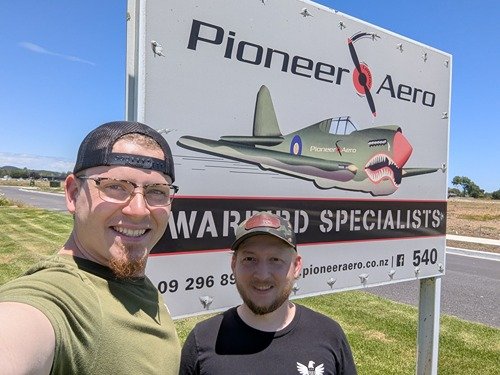
Erik and Nate at Pioneer Aero
Two of our gunsmiths Erik and Nate traveled to New Zealand with two primary objectives. First, we needed to recover as many of the non-regulated installation components as possible, including feed boxes, feed chutes, barrel shrouds, mounts, and support equipment. Second, we needed to learn everything we could about the aircraft's blank-firing system.
Reverse Engineering the M2 Blank-Firing System
While in New Zealand, Erik spent time reverse engineering the blank-firing system that had been developed for the aircraft. Pioneer Aero Restorations generously shared their experience with the blank firing, and that information became the foundation for much of our later development work.
At first glance, making a machine gun fire blanks sounds simple. In reality, blank-firing systems are often more difficult to tune than guns firing live ammunition. Without a projectile traveling down the barrel, the firearm must rely entirely on the blank-firing adapter and ammunition load to generate enough pressure to cycle the action reliably.
However, duplicating the existing design was only part of the challenge. Operating six blank firing aircraft machine guns can become expensive. At full cyclic rate, the six-gun system can consume well over 100 rounds every second. Depending on ammunition prices, only a few seconds of firing can cost hundreds to thousands of dollars.
While a standard M2 typically fires around 450 rounds per minute, aircraft variants commonly operate around 1,000 to 1,200 rounds per minute. Because the aircraft version of the M2 cools in the airflow around the plane, they can be built lighter and tuned for significantly higher rates of fire.
Because these guns would spend their lives performing at airshows rather than fighting a war, reducing wear, simplifying maintenance, and lowering operating costs became important goals.
Our objective was to create a system that preserved the realism and excitement spectators expect while making long-term operation practical for a flying museum aircraft.
Manufacturing Six Aircraft M2 Machine Guns
Working together with Soaring by the Sea, we developed a plan to manufacture all six guns. While Erik consulted extensively on the production of the serialized and regulated portions of the firearms, Soaring by the Sea served as the legal manufacturer for those components.
Building six aircraft machine guns required far more than simply assembling parts. McCluskey Arms was responsible for sourcing, manufacturing, fitting, and assembling the remaining components required to complete the project.
Finding parts for aircraft machine guns is increasingly difficult. Many original parts have become scarce, and available inventories are often incomplete, heavily worn, or configured for entirely different applications. Erik spent countless hours locating parts kits.
Aircraft barrels proved especially challenging. Unlike standard M2 barrels, aircraft machine gun barrels were designed for a completely different operating environment. Because they are cooled by the airflow generated during flight, aircraft barrels are lighter than their ground-based counterparts. Original aircraft barrels are difficult to find, and many available examples have already been consumed by decades of military service, post-war use, or previous restoration projects.
Even when parts could be located, they were not always the correct configuration. Many of the available assemblies were ANM aircraft guns rather than the exact configuration required for the P-40 installation. As a result, components frequently had to be modified, adapted, or rebuilt to meet the requirements of the project.
When parts could not be sourced, we manufactured them in-house. Backplates, side plates, blank-firing adapters, and numerous supporting components were manufactured specifically for this project. Components had to be measured, engineered, manufactured, fitted, and tested. Newly manufactured parts then had to function alongside original military components that were more than eighty years old.
Once complete, all six guns were parkerized to provide corrosion resistance and a historically appropriate military finish.
By the end of the project, each gun represented a combination of restoration, reverse engineering, custom manufacturing, and careful assembly.
Test Firing the M2s
Blank Firing
Normally, live-fire testing would be the first step. Blank-firing systems are notoriously more difficult to tune than guns firing live ammunition. Usually, establishing a reliable live-fire baseline is the best place to start. However, we had an upcoming open house event with Soaring by the Sea and needed the blank-firing system operational for the demonstration. Because of that deadline, we made the decision to tackle the more difficult problem first.
Unlike live ammunition, there is no projectile traveling through the barrel to generate normal operating conditions. Instead, the entire system depends on the blank-firing adapter and ammunition load working together to produce sufficient pressure to cycle the action.
The objective was to create a setup that would produce realistic firing effects while minimizing wear and reducing operating costs. Too little pressure and the gun will not function reliably. Too much pressure and unnecessary wear is created.
Rather than relying exclusively on military surplus blanks, we developed ammunition specifically for this application. Military blanks are much more energetic than necessary for an airshow demonstration aircraft. Excessive pressure increases wear, accelerates maintenance requirements, and raises operating costs.
By tailoring ammunition to this application, we were able to create a system that was easier on the guns while still producing the visual and auditory effect expected by spectators. Many hours were spent evaluating reliability, cyclic rate, maintenance requirements, and overall performance. The result was a system that balanced realism, reliability, and long-term sustainability.
To support testing, Erik designed and built a dedicated electronic firing system that simulated the aircraft's controls while the guns remained safely mounted on the ground. This allowed us to test solenoids, firing circuits, and overall system operation before the guns were installed in the aircraft.
Live Fire
With the blank-firing system functioning reliably, we were finally able to transition to live-fire testing.
The purpose of live-fire testing was straightforward: establish a reliable baseline and verify the function of each gun using live ammunition. Every gun was individually evaluated for timing, feeding, extraction, ejection, and overall reliability.
By the end of testing, all six guns had demonstrated reliable operation in both live-fire and blank-fire configurations, providing confidence before final installation into the aircraft.
Installing and Testing the Guns in the P-40
Individual machine guns can be tested on a bench, but a complete aircraft weapons system can only be fully evaluated once everything is installed and functioning together. Feed systems, electrical controls, mounts, ammunition routing, and gun timing all have to work simultaneously. Seeing the complete system operate successfully in the aircraft was confirmation that months of development had paid off.
Finally, we were ready to test fire in the aircraft. This phase represented the culmination of hundreds of hours of labor.
Every gun must fit correctly within the wing structure while interfacing properly with feed systems, electrical controls, mounts, and surrounding aircraft components. The feed chutes, ammunition boxes, mounts, and support equipment recovered from New Zealand all came together during this stage of the project.
With the guns and system components installed, final operational testing could begin.
Watching all six guns operate in the aircraft for the first time was one of the most rewarding moments of the entire project. Components that had been designed, manufactured, repaired, modified, tested, and tuned were finally functioning together as a complete aircraft armament system.
Transporting the M2s for Airshows
To support transportation and long-term storage, we worked with DLX in Eugene to create custom transport cases. These cases protect the guns during travel to airshows and public events while simplifying installation and removal.
Malakya, our resident welder, also built a dedicated transport cart capable of safely carrying all six machine guns together. This allows the guns to be moved efficiently during maintenance, installation, and event preparation.
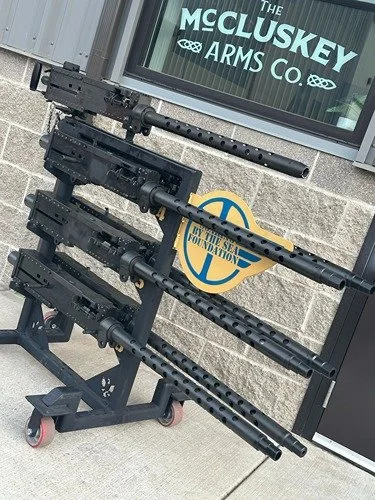
We are also developing detailed documentation for airshows covering installation procedures, removal procedures, maintenance schedules, troubleshooting, and operating instructions. The goal is to ensure these guns remain serviceable for decades to come.
More About the P-40
The Curtiss P-40 Warhawk remains one of the most iconic fighter aircraft of World War II. Armed with six .50 caliber machine guns, the aircraft served in multiple combat theaters and became one of the most recognizable Allied fighters of the war.
Depending on the variant, the P-40 could reach speeds approaching 378 miles per hour.
This particular aircraft was built in Buffalo, New York, and later served in the Pacific Theater. After decades away from the skies, it was recovered, restored in New Zealand, and eventually returned to flying condition before being acquired by Soaring by the Sea and brought back to the United States.
Future Projects with Soaring by the Sea
The P-40 project is only the beginning of our relationship with Soaring by the Sea. In addition to supporting the P-40, we are currently assisting with machine gun systems for their Huey helicopter and helping develop replica ordnance for their Skyraider.
Historic aircraft require specialized support, and we are proud to play a role in keeping these remarkable machines flying and demonstrating aviation history for future generations.
To learn more about Soaring by the Sea or support their mission of preserving aviation history, please visit their website and consider making a donation.